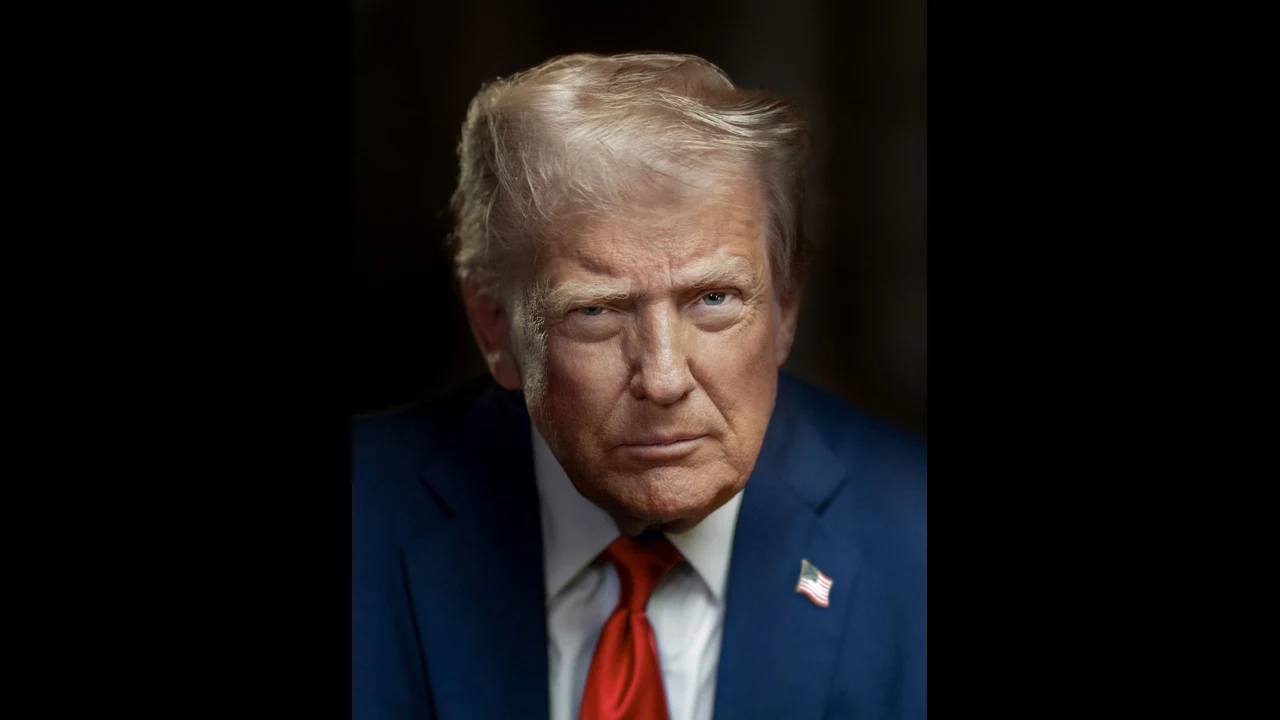
President Donald Trump said on Friday that the war with Iran will end soon, even as a wave of American military movements and warnings to Gulf allies has raised expectations of a fresh round of strikes after the midterm elections. Speaking in an interview with Kansas City radio station KCMO while campaigning ahead of the November 3 vote, Trump said the conflict was close to a conclusion but offered no timetable or plan for how it would be brought to a close.
“It’s going to get wrapped up soon,” Trump said in the interview, adding that Washington needed a guarantee that Iran would never possess a nuclear weapon. Preventing Iran from acquiring a nuclear weapon has remained the central stated objective of the American campaign throughout the conflict, and Trump has repeated that condition in public remarks for months.
A promise tied to the election calendar
Trump has said the United States would not strike Iran before the midterm elections, and the conflict has become a major issue in the final days of campaigning. At a recent rally in Florida, he suggested the United States could launch another round of strikes similar to the operation that began the war in February, telling supporters: “We may do another little Epic Fury, or they’ll agree — if they’re smart, they’ll just say, ‘Let’s get down to business.’ But you know, I doubt they’ll do that because perhaps they’re not smart.”
At a campaign rally in Lubbock, Texas, earlier in the week, Trump struck a similar note, telling the crowd: “You’ll see Iran in a couple of weeks, if you don’t mind.” He added: “We obliterated Iran’s nuclear enrichment capacity with Operation Midnight Hammer and Operation Epic Fury and defeated them militarily, financially and otherwise. And it will all end very soon.” On another occasion he said: “It could be over whenever I wanted it to be over.”
Reports in recent days have suggested that the election calendar may be shaping the timing of any next step. Axios, citing a United States official, reported that Trump could be more inclined to order a major military operation against Iran if Republicans suffer heavy losses in the midterm elections. A White House official told the same outlet that the election results would not influence Trump’s decisions on Iran, and no final decision on a new operation has been reported.
Military buildup reported across the region
Signs of continued American military activity have added to the uncertainty over whether diplomacy or a new campaign comes next. The Times of Israel reported on Thursday that more than 10 United States military transport aircraft had landed at the Ovda and Nevatim airbases in southern Israel over the past week, citing analysts monitoring open-source flight-tracking data. Other American military cargo flights were also reported at bases in Jordan, Saudi Arabia, Qatar and Kuwait.
The Wall Street Journal reported that Admiral Brad Cooper, chief of United States Central Command, met Trump at the White House on Thursday to brief him on military options involving Iran. Cooper was accompanied by Defence Secretary Pete Hegseth and Joint Chiefs of Staff Chairman General Dan Caine, according to the report. Cooper rarely briefs Trump in person, and the meeting has been interpreted as a sign of heightened American military preparations in the Middle East.
Earlier reporting by the Wall Street Journal, carried on October 28, said the United States had told several Gulf Arab countries to prepare for a “short, intense military campaign” against Iran after the November 3 midterm elections. According to that report, the American military is moving a Patriot missile defence system from Texas to the region and has moved troops from bases where they were vulnerable, while forces are restocking munitions and preparing bombers and fighter jets for strikes. An additional aircraft carrier strike group and a Marine expeditionary unit are expected to join roughly 20 American warships in the Middle East next month, the report said. It added that Trump had not made a final decision but was leaning toward a large post-election attack that could target Iranian infrastructure and nuclear sites. The White House declined to comment on what it described as sensitive military plans.
Diplomacy still running alongside the warnings
Diplomatic efforts to revive negotiations have continued in parallel with the military signals, although no breakthrough has been reported. Trump said on Wednesday that Vice President JD Vance’s outreach to Iran was aimed at helping the country obtain medical supplies, following reports that Vance had sent a letter to Iran’s top security official seeking to revive stalled peace talks. Iran has received the letter but has yet to respond, the semi-official Tasnim news agency reported on Thursday.
In separate remarks in the Oval Office, Trump played down the idea that Washington was in a rush, saying Iran was in difficulty and time was on America’s side. “They’re in trouble and we have time,” he told reporters, describing the conflict as a war but “not a typical war” that had now lasted seven months. He also said American financial outlays on the conflict remained minimal relative to the scale of the campaign, and claimed the money spent had been more than made up for elsewhere, although he did not provide figures to support that claim.
Public opinion at home appears divided over the campaign. A recent Harvard CAPS-Harris poll found that only 35 per cent of registered voters approved of Trump’s handling of the Iran war. The first seven-and-a-half months of the conflict have cost American taxpayers more than $47 billion, according to Pentagon figures provided to Congress and cited in reporting on the poll.
Why the Strait of Hormuz matters
Much of the war has centred on shipping through the Strait of Hormuz, the narrow waterway between Iran and Oman through which a large share of the world’s oil supply passes. Iran responded to the initial American and Israeli attacks with missile and drone attacks in the region and moves that effectively disrupted energy exports through the strait.
American officials say a protected shipping route through the strait has now allowed oil shipments to climb back toward pre-war levels despite continuing Iranian attacks, and that Washington has completely cut off oil exports from Iran with its own blockade. Cooper said on Friday, in a video recorded during a recent flight over the strait, that he saw no Iranian military presence there. “Iran’s Navy is all at the bottom of the sea,” he said, adding: “I saw dozens of commercial vessels transiting. All types. Cargo, crude oil, liquid natural gas, or LNG.” He said American forces were ensuring the shipping lanes remained free from Iranian sea mines after a major operation to remove the devices, and the American military says it has helped Gulf countries export more than 1.5 billion barrels of crude oil since the summer.
Background: how the war began
The conflict began on February 28, 2026, with coordinated American and Israeli strikes targeting missile facilities, military installations and nuclear infrastructure inside Iran. Tehran responded with missile and drone attacks against targets in the region, and the fighting has continued in varying intensity ever since, with diplomatic efforts repeatedly stalling.
Control of the Strait of Hormuz and the question of Iran’s nuclear programme have remained the two issues at the heart of every round of talks. Washington has maintained that any settlement must include a firm guarantee on nuclear weapons, while Tehran has sought relief from military pressure and economic restrictions. Neither side has publicly described a draft agreement, and officials on both sides have spoken in recent weeks more about preparing for further fighting than about closing a deal.
Reactions and what happens next
Reactions to Trump’s latest remarks have split along familiar lines. Supporters of the administration point to the restored shipping route through the strait and the damage claimed against Iran’s nuclear enrichment capacity as evidence that American pressure is working. Critics point to the cost of the campaign, the poll numbers on public approval, and the risk that a new round of strikes after the election could widen a conflict that has already lasted more than seven months.
What happens next is likely to be decided in the days after the midterm elections. If Trump follows the path suggested by recent reporting, Gulf allies have already been warned to expect a short and intense campaign. If diplomacy gains ground instead, the Vance outreach and the medical-supplies channel could become the first step toward a wider negotiation. For now, both tracks remain open: American aircraft continue to move across the region, the White House continues to brief military options, and the president continues to say the war will end soon, without saying how.