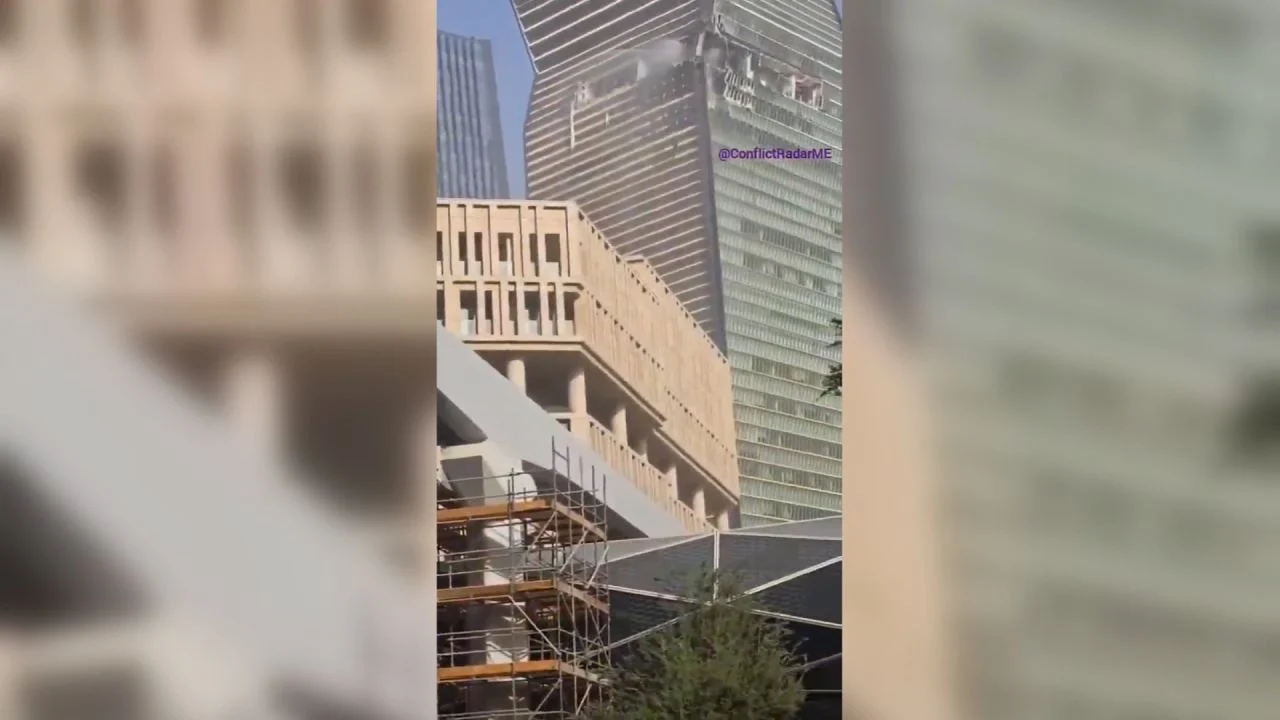
A Saudi Aramco building in Riyadh was damaged on Sunday after missiles were fired at the Saudi capital, Saudi officials said. Falling debris hit the building in the city’s financial district. No one was hurt.
Saudi Arabia’s Energy Ministry said an administrative building belonging to Aramco was hit by falling shrapnel during an attempted attack. The ministry said the damage was limited and no one was killed or injured.
Missiles Intercepted Over Riyadh
Saudi air defences stopped the attack before the missiles could reach their targets, the Saudi-led coalition said. Two ballistic missiles fired toward Riyadh were intercepted and destroyed. Two cruise missiles were also shot down, in Riyadh and the southern region, and one drone was intercepted.
Saudi Civil Defence had issued an early warning of a possible threat in the Riyadh area earlier in the day. Officials later said the danger had passed.
A loud explosion was heard in the city on Sunday morning. One witness said ambulances were seen heading toward the area.
Aramco Tower Damage in Financial District
A Reuters witness saw blown-out windows across several floors of the Aramco Tower, one of the tallest buildings in the King Abdullah Financial District.
Video circulating online and verified by CNN showed damage to several floors of the building, with windows blown out. Saudi officials described the impact as minimal.
The building is an office block, not a refinery or an oil plant. Aramco did not immediately comment.
Why Houthis Strike Saudi Targets
The Houthis, an armed group from Yemen also known as Ansar Allah, said the Riyadh attack was one of several strikes on Aramco targets. Their military spokesman, Yahya Saree, said the group had also targeted King Khalid International Airport, Aramco sites in Riyadh and Khurais, and a pumping station in Dawadmi.
The Houthis have been firing missiles and drones at Saudi Arabia for three months. They say they will keep firing as long as Saudi Arabia bombs the parts of Yemen they control and blocks their territory.
A senior Houthi official, Mahdi al-Mashat, said on Saturday: “We will punish the Saudi regime for its crimes against the Yemeni people.”
Aramco is the world’s biggest oil producer. Attacks on its buildings and sites matter far beyond Saudi Arabia because they can shake oil markets and energy supplies.
Saudi Arabia spent $83 billion on defence last year, according to the Stockholm International Peace Research Institute. It has US fighter jets and Patriot and THAAD air defence systems, plus weapons from France and the United Kingdom. But the country is huge — about one-fifth the size of the United States — and faces threats on three sides, from Iran, armed groups in Iraq, and the Houthis.
Analysts say the Houthis have learned to fire ballistic and cruise missiles together with long-range drones to overwhelm Saudi defences. Many missiles are shot down, but some get through.
Yemen Conflict Escalation Since July
Fighting between the Houthis and Saudi Arabia flared up again in July, when a 2022 ceasefire broke down. The Houthis announced a blockade of Saudi ports. In September they seized much of Yemen’s Red Sea coast. In October, government forces launched a campaign to take back Houthi-held land, including the capital, Sanaa.
The United Nations says more than 1,600 people have been killed and almost 300,000 forced from their homes since the ceasefire collapsed.
The Houthis have also struck airports and oil sites across Saudi Arabia. On 10 October, at least 13 people were killed and more than 300 wounded in a Houthi strike on Riyadh airport. Aramco’s headquarters suffered extensive damage in an attack in October.
A day before the Riyadh attack, Houthi health officials said Saudi air strikes had killed at least 33 people near Sanaa, including women and children. The strikes hit the village of al-Shariyah, east of the capital. Houthi officials said 39 more people were wounded. Saudi Arabia has not commented on those claims, and they could not be independently verified.
On Friday, an attack on a market in Taiz province killed 30 people. The Houthis blamed Saudi air strikes; Yemeni government forces accused the Houthis of firing a ballistic missile at the site.
The wider Gulf is also tense. Iran’s Revolutionary Guards said on Sunday that two oil tankers had caught fire after hitting mines in the Strait of Hormuz, and a third tanker had also caught fire. Reuters said it could not confirm those reports. On Saturday, the US military said it had disabled a commercial vessel in the Gulf of Oman. Qatar, which is trying to mediate between the US and Iran, denied reports on Saturday that talks had failed.
| Ballistic missiles intercepted toward Riyadh | 2 |
| Cruise missiles intercepted | 2 |
| Drone intercepted | 1 |
| Casualties in Riyadh attack | 0 |
| Aramco Tower damage | Windows blown out across several floors |
| Saudi defence spending last year | $83 billion |
| Killed in 10 October Riyadh airport strike | At least 13 |
| Killed near Sanaa on Saturday (Houthi ministry figure) | At least 33 |
| Killed since July ceasefire collapse (UN) | 1,600+ |
| Displaced since July (UN) | Almost 300,000 |
Falling debris damaged an administrative Aramco building in Riyadh’s financial district on Sunday after a missile attack. Several floors had windows blown out. No one was hurt.
The Houthis said they carried out the attack as part of several strikes on Aramco targets. Saudi air defences intercepted the missiles.
No. Saudi Arabia’s Energy Ministry said there were no injuries or deaths. The damage was limited to the building.