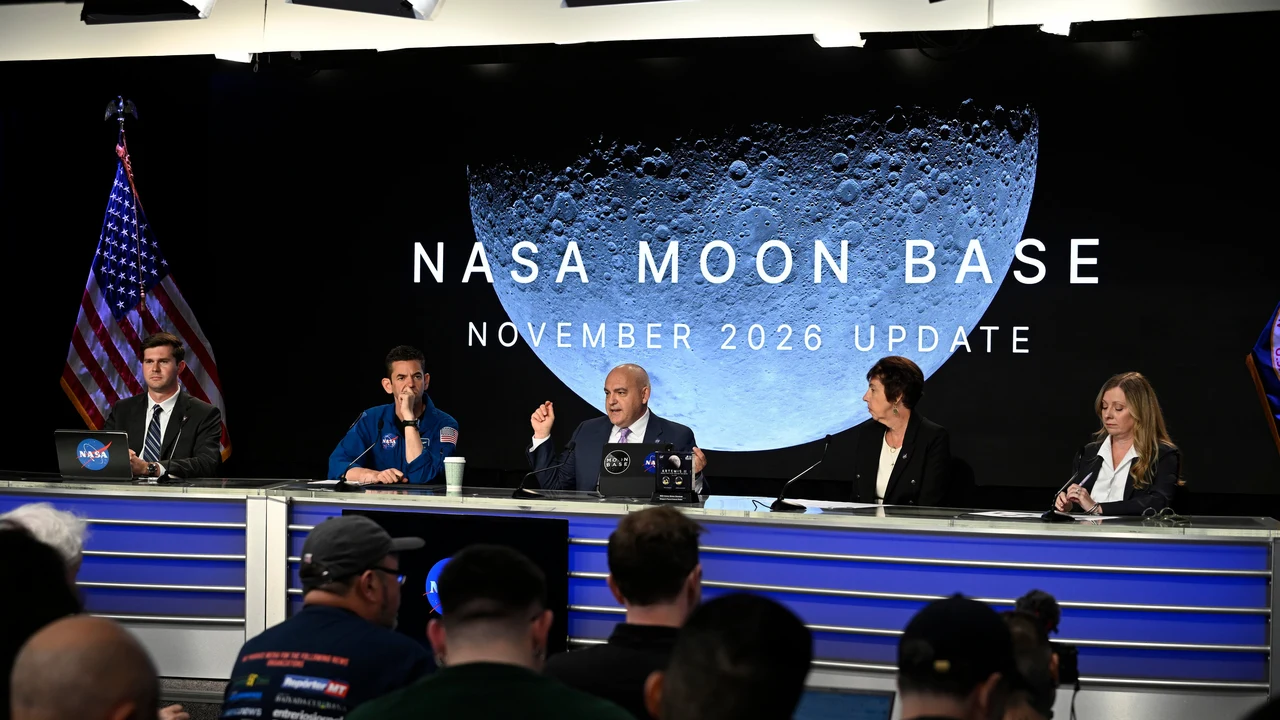
NASA Moon Base Plan in Numbers
NASA has opened the door for private companies to help build its planned base on the Moon. The US space agency announced on Saturday that eight firms, including Elon Musk’s SpaceX and Jeff Bezos’s Blue Origin, can now compete for lunar delivery work worth up to $10 billion over the next ten years.
The announcement came at the MAX POWER aerospace expo at Kennedy Space Center in Florida. It is the biggest single step yet in NASA’s plan to set up a lasting home for astronauts near the Moon’s South Pole, with machines and supplies landing there before people arrive.
|
CLPS 2 ceiling |
$10 billion over 10 years |
|
Companies eligible |
8 |
|
Current CLPS ceiling |
$2.6 billion raised to $4.2 billion |
|
PROMISE rover delivery |
$94 million + $140 million option |
|
Transport task orders |
About $1.3 billion, 6 orders |
|
PROMISE launch target |
Late 2028, 18-month mission |
|
Guaranteed minimum per firm |
$25,000 |
Eight Companies Chosen for Lunar Deliveries
NASA does not build every Moon lander itself any more. Under a scheme called Commercial Lunar Payload Services, or CLPS, the agency pays private firms to carry its science gear and equipment to the lunar surface. The new deal, known as CLPS 2, is the next round of that scheme, and it runs for ten years.
The eight firms are Blue Origin, Firefly Aerospace, Intuitive Machines, iSpace US, Lockheed Martin Space, Northrop Grumman Space Systems, SpaceX and Voyager Technologies. Each one can now bid for delivery jobs as NASA hands them out, one mission at a time.
One point needs care. The $10 billion figure is a ceiling, not a cheque. It is the most NASA could spend across all eight firms over ten years. Each firm is only guaranteed $25,000 under its base contract. Real money flows only when NASA awards a specific delivery mission. The agency also raised the ceiling on its current CLPS contract from $2.6 billion to $4.2 billion to fund the first phase of Moon Base work. That contract stays in place through November 2028, with deliveries running through November 2033.
Nuclear Rover PROMISE Heads for South Pole
The clearest payday of the day went to Blue Origin. NASA gave the firm a $94 million base contract, with a further $140 million available on performance, to deliver a nuclear-powered rover called PROMISE to the Moon’s South Pole.
PROMISE stands for Polar Rover for Observation, Mapping, and In-Situ Exploration. It is a six-wheeled rover that will drill about one metre into lunar dust to look for water ice and other resources hidden below the surface. It will also carry instruments to study the chemical makeup of the soil, plus temperature and radiation sensors and cameras.
NASA’s Jet Propulsion Laboratory will build the rover using spare flight parts and test models from its Curiosity and Perseverance Mars rovers, a move the agency says will cut costs. Blue Origin will carry it on its Mark 1 lander. NASA is aiming for a launch in late 2028, with an 18-month mission on the surface.
Why Moon Base Matters for Mars
NASA also handed out six transport task orders worth about $1.3 billion combined to Arrow Science and Technology, Blue Origin and Impulse Space. Those missions will test how to move cargo between Earth and the Moon, including a spacecraft called CAPSTONE 02 and small MoonFall drones that will scout the South Pole before astronauts arrive. Launches will ride on Blue Origin’s New Glenn, Relativity Space’s Terran R and SpaceX’s Falcon 9 rockets.
SpaceX won a separate job: flying communications satellites aboard its Starship rocket into the space between Earth and the Moon in 2028, to test the links future lunar crews will need. NASA also gave awards to Honeybee Robotics, Redwire and Yank Technologies for parts of a planned lunar power and communications tower, combining solar power with wireless power transfer.
So why does the South Pole matter so much? Water ice sits in its dark, cold craters. That ice can be turned into drinking water, breathable oxygen and even rocket fuel, which is why NASA wants its base there. A working base would let astronauts stay far longer than a short visit, and NASA says the lessons from living and working on the Moon will feed directly into crewed missions to Mars one day.
NASA Administrator Jared Isaacman summed up the plan in a statement: “We are building the Moon Base mission by mission. When our astronauts return to the Moon, they will arrive with the first elements of the Moon Base already waiting for them on the surface.”
CLPS 2 is NASA’s new ten-year framework for lunar deliveries. Eight companies are eligible to compete for delivery missions, with a combined maximum value of $10 billion. Firms bid for each job; the $10 billion is a ceiling, not money already paid out.
NASA is targeting a late-2028 launch. Blue Origin will deliver the nuclear-powered rover to the lunar South Pole on its Mark 1 lander, for an 18-month mission hunting for water ice.
No. The $10 billion is the most NASA could spend under CLPS 2 over ten years, and each firm is only guaranteed $25,000. Concrete awards so far are the $94 million PROMISE delivery deal and about $1.3 billion in transport task orders.