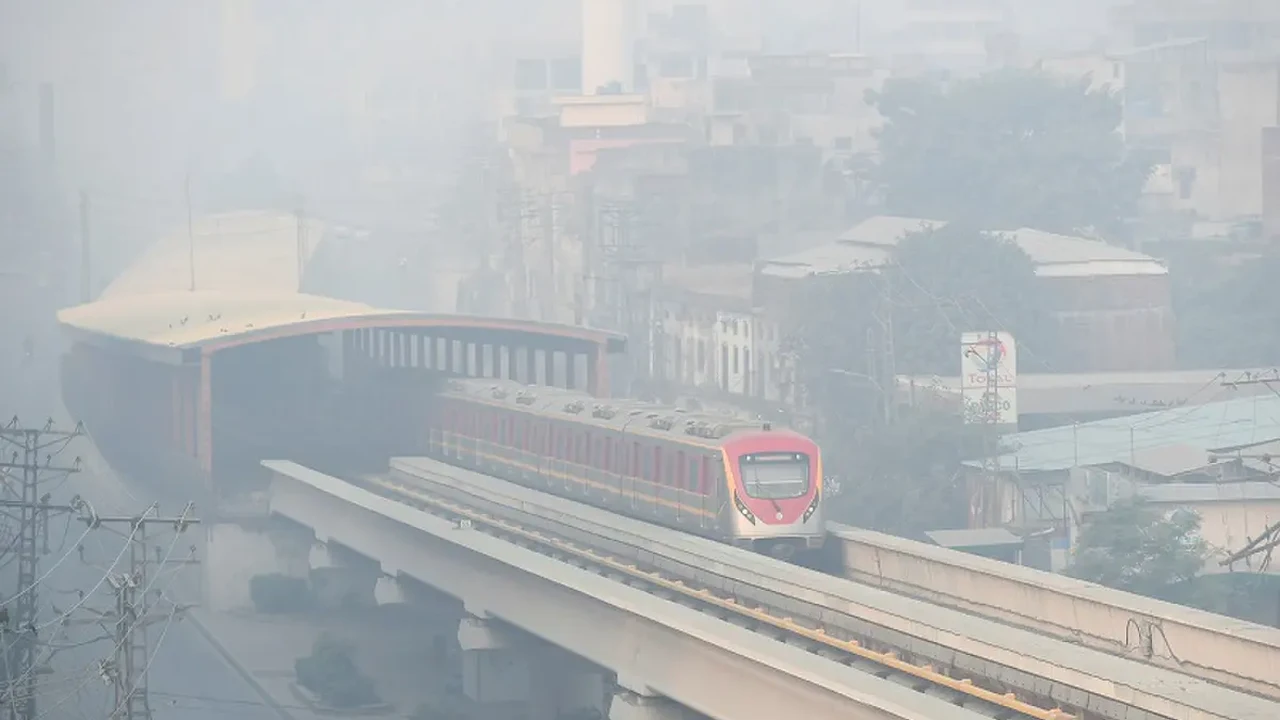
Lahore was ranked the world’s most polluted major city on Monday, November 9, 2026, as its air quality index climbed past 600 into the hazardous zone. Swiss monitor IQAir placed the city at the top of its live global ranking for major cities, with an hourly reading of 647 during the morning.
The air in Lahore was more than three times as dirty as in the second-ranked city. IQAir’s 9am to 10am ranking put Lahore at 590, while Ulaanbaatar in Mongolia stood at 177. Delhi followed at 174, Kolkata at 173 and Sarajevo at 170.
AQI is a simple scale that shows how clean or dirty the air is. A reading above 300 means the air is hazardous — unsafe to breathe for everyone, not just people with health problems. Lahore crossed that line by a wide margin on Monday morning.
Lahore Leads Global Pollution Ranking
The worst readings came from individual monitoring stations across the city. Allama Iqbal Town recorded an AQI of 1,033, the CERP Office area stood at 864, and Paragon on Burki Road reached 748. These are among the highest station readings seen in the city this season.
The tiny dust in the air, known as PM2.5, is the main problem. These particles are so small that they pass deep into the lungs and enter the blood. On Monday morning, Lahore’s PM2.5 level reached 357 micrograms per cubic metre — nearly 80 times the yearly safe limit set by the World Health Organization.
Pollution in Lahore rises sharply in the early morning and late at night. That is when the smog grows thick and forces people to stay indoors. Health experts say air pollution is the second-biggest risk factor for deaths around the world, claiming about 8.1 million lives every year. Tiny outdoor particles alone account for 4.7 million of those deaths.
Smog Spreads Across Punjab
The crisis is not limited to Lahore. IQAir’s live Pakistan ranking showed Raiwind at 688, Multan at 655, Lahore at 639 and Faisalabad at 600 — every one of them in the hazardous category.
Smog season in Punjab starts in late October, peaks from November to January and runs through February. Cold, still air traps smoke and dust close to the ground, so the pollution has nowhere to go. That is why the same cities appear at the top of the rankings year after year.
The Punjab government has forecast that pollution levels will stay high on November 9 and 10, with a slight improvement expected from November 11. The Environment Protection Department is due to release comparative findings on November 10, showing how much each source added to the problem.
Why Air Turned So Bad
Several causes came together on the same morning. A day earlier, the Punjab government had warned that smoke from Diwali fireworks in neighbouring Indian Punjab, crop-residue burning and easterly winds could make Lahore’s air worse. A special report issued on November 8 predicted the smoke could reach Lahore within five to 13 hours.
The report said fireworks, burning of crop leftovers and still night air were all pushing pollution up. Amritsar, about 50 kilometres from Lahore, was named as a possible source of smoke crossing the border. The report also counted 2,347 incidents of crop-residue burning in Indian Punjab up to November 4. Of those, 1,081 were in Tarn Taran, Ferozepur and Amritsar — the three districts facing Lahore and Kasur — making up 46 per cent of the total.
But the picture is more complex than one side of the border. Satellite data analysed by Hamari Hawa, using NASA’s VIIRS system, found 13,241 fire detections in Pakistani Punjab between October 1 and 29, compared with 3,158 in Indian Punjab — more than four times as many. About 92 per cent of the detections on the Pakistani side were on farmland.
A closer look found 7,130 crop-linked fire detections within 100 kilometres of Lahore between October 15 and November 1, including 781 within 40 kilometres of central Lahore. District figures included Sheikhupura (322), Tarn Taran (149), Amritsar (106), Nankana Sahib (77), Lahore (62) and Kasur (50). Satellite detections show fire activity; they are not proof of each single burning incident.
Punjab Senior Minister Marriyum Aurangzeb linked the worsening smog to large-scale Diwali fireworks in India, saying polluted winds entered through the eastern corridor. In a post on X, she said local pollution was being controlled under Chief Minister Maryam Nawaz’s direction, and that preventive steps had kept the AQI from rising above forecast levels, as had happened in past years.
The minister said air quality was expected to improve within two to three hours on Monday as wind direction and speed changed, along with sunshine. She added that all relevant departments were working in the field.
Meanwhile, the Environment Protection Agency Punjab reported 679 farm fire incidents across the province, of which 650 had been put out. Night squads, drones, tractor-mounted water bowsers and Quick Response Units are working in farm areas. The agency’s Climate Watch Hub uses satellite alerts to warn district teams, and Director General Abdullah Nayyar Sheikh has told field officers to treat anti-burning work as a priority, with surprise checks along motorways and main roads.
Notably, Lahore’s night-time PM2.5 level had already reached 202 micrograms per cubic metre before Diwali — a sign that local pollution alone was already far above safe limits.
Staying Safe During Smog
The senior minister advised older people and children to avoid going outside unless necessary, and asked residents to keep windows, ventilators and doors shut so dirty air stays out of homes. Children, older people, pregnant women and people with heart, lung or breathing problems were advised to stay indoors until the AQI improves.
She also asked the public to pause morning walks, jogging, cycling and other outdoor exercise for now. People travelling by car should keep windows closed and switch the air conditioning to recirculation mode. Residents were also asked not to burn rubbish, leaves or other material near their homes.
Delhi, across the border, was the third-most polluted city in the world on Monday morning. Many areas of the Indian capital showed readings above 400, classed as severe, after fireworks went off in breach of court orders. Delhi has asked schools to hold online classes under its graded action plan.
Key Facts
| Fact | Detail |
|---|---|
| Lahore AQI (9–10am ranking) | 590 — top of IQAir global major-city list |
| Lahore hourly peak | 647 — hazardous category |
| Second-ranked city | Ulaanbaatar, 177 — Lahore more than 3x higher |
| Delhi / Kolkata / Sarajevo | 174 / 173 / 170 |
| PM2.5 (morning) | 357 µg/m³ — 79.8x WHO yearly limit |
| Worst station | Allama Iqbal Town, 1,033 |
| CERP Office / Paragon | 864 / 748 |
| Raiwind / Multan / Faisalabad | 688 / 655 / 600 — all hazardous |
| Crop fires, Indian Punjab (to Nov 4) | 2,347 incidents; 1,081 in Tarn Taran, Ferozepur, Amritsar |
| Fire detections, Pakistani Punjab (Oct 1–29) | 13,241 vs 3,158 in Indian Punjab (NASA VIIRS) |
| EPA Punjab farm fires | 679 reported, 650 extinguished |
| Forecast | High Nov 9–10; slight improvement from Nov 11 |
| EPD comparative findings due | Nov 10 |
FAQs
Q1: What was Lahore’s AQI on November 9?
A: Lahore topped IQAir’s live ranking of major cities with an AQI of 590 between 9am and 10am, while a separate hourly reading reached 647. Both figures sit deep in the hazardous category.
Q2: Why did Lahore’s air get so bad?
A: Several causes came together: smoke from Diwali fireworks, crop-residue burning on both sides of the border, easterly winds carrying polluted air, and still night air that traps smoke close to the ground. Satellite data shows far more fire detections in Pakistani Punjab than in Indian Punjab this season.
Q3: When will the air improve?
A: The Punjab government expects pollution to stay high on November 9 and 10, with a slight improvement from November 11. The senior minister said Monday’s air could improve within a few hours as wind direction changed. The Environment Protection Department will release findings on November 10.