New Zealand’s general election ended without a clear winner on Saturday, 7 November 2026. Prime Minister Christopher Luxon’s National Party and its coalition partners held a wafer-thin lead, but the result stayed too close to call. Nobody could say on election night who would form the next government.
With nearly all votes counted, Luxon’s right-wing bloc held 67 seats — just one above the 66 needed for a majority. The left-wing bloc held 57 seats, and a new centrist party held seven. Final results arrive on 27 November, once special votes are counted, and those late votes could still change the outcome.
Luxon Coalition Holds Slim Lead
Luxon’s National Party won about 29.3 per cent of the party vote, almost level with Labour, led by Chris Hipkins, also on about 29.3 per cent. Both big parties fell below 30 per cent, a sign of how little enthusiasm voters showed for either of them. National dropped sharply from the 38 per cent it won in 2023.
National is projected to win 42 seats. Its partners gained ground: the libertarian ACT Party took 13 seats, and the populist New Zealand First Party took 12. Together, the three parties hold 67 seats.
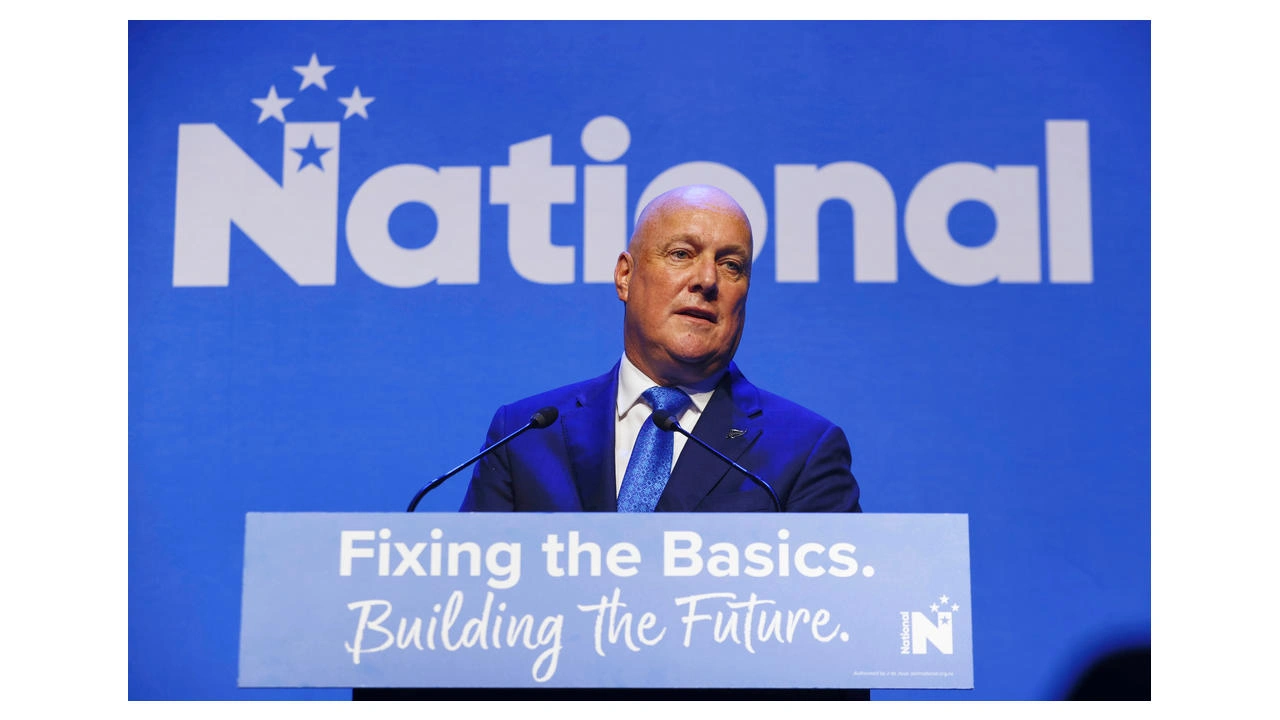
Luxon did not claim victory in his speech to supporters in Auckland. “National is once again the largest party in parliament and we have a pathway to forming the next government,” he said. “But I have to tell you right now it is too close to call.”
Hipkins also refused to concede defeat. Speaking at Labour headquarters in Upper Hutt, outside Wellington, he told supporters: “Tonight, New Zealand has spoken. It may take us a little bit longer to figure out exactly what it is that you’ve said.”
Labour is projected to win 36 seats. Its partners, the Greens, won 16 seats — their best result ever — and Te Pati Maori, an Indigenous rights party, won five. Together, the left bloc holds 57 seats.
Opportunity Party Enters Parliament
One story of the night was a new centrist party. The Opportunity Party, led by 38-year-old Qiulae Wong, won about 6 per cent of the vote and seven seats. It is the first new party to enter Parliament in more than a decade.
Wong has promised a non-partisan and practical agenda, built on socially liberal, technocratic and pro-environment ideas. Her party’s flagship policy is a universal basic income paid for by a land value tax.
Wong has said she is open to talking with either side if she holds the balance of power, and would deal first with whichever big party won the most votes. Luxon has ruled out governing with Opportunity, but analysts say both leaders would likely take her call if she held the only path to power.
Why Final Result Takes Until November 27
New Zealand uses a mixed-member proportional system, known as MMP. Every voter casts two votes: one for a party, and one for a local candidate. A party needs 5 per cent of the party vote, or one local seat, to enter Parliament. The total size of Parliament can grow above the usual 120 seats when a party wins more local seats than its vote share allows — an effect called an overhang.
That quirk matters this time. National won most local seats even as its vote share fell, so Parliament is set to grow to about 130 seats. That pushed the number needed for a majority up to 66.
Hundreds of thousands of special votes still need counting. These are votes cast by New Zealanders living abroad, or by people voting outside their home area. Special votes have favoured the left in past elections: in the last four elections, National lost one or two seats when they were counted, while left-wing parties gained one to three seats. That is why the final result may not be known until 27 November.
The night also brought shocks for National’s senior figures. Finance Minister Nicola Willis, Speaker of the House Gerry Brownlee, and Defence and Justice Minister Paul Goldsmith all looked set to lose their seats.
What Happens Next in Wellington
Coalition talks in New Zealand often take weeks, even when a majority is clear. With a margin of one seat, talks could take longer. Luxon will head a caretaker government while the count finishes.
Three paths are open. First, the right-wing bloc could keep its slim majority and return to power, though it would govern with almost no room for error. Second, Luxon could need Opportunity’s support, despite ruling that out. Third, if special votes shift enough seats, Labour plus the Greens, Te Pati Maori and Opportunity could reach a majority instead.
The campaign was dominated by the cost of living. Prices, jobs and household budgets shaped the vote, and polls before election day showed little public enthusiasm for either Luxon or Hipkins. Voters answered by boosting smaller parties on both sides, and the minor parties now hold real bargaining power over the next government.
| Party | Party vote | Seats |
|---|---|---|
| National | about 29.3% | 42 |
| Labour | about 29.3% | 36 |
| Green Party | 13.3% | 16 |
| ACT | 11.0% | 13 |
| New Zealand First | 9.8% | 12 |
| Opportunity Party | 6.0% | 7 |
| Te Pati Maori | 0.6% | 5 |
Figures are preliminary results with nearly all votes counted; final results due 27 November 2026.
Final official results, including special votes, are due on 27 November 2026. Coalition talks can then begin in earnest.
New Zealand uses MMP. Voters cast one vote for a party and one for a local candidate. A party needs 5 per cent of the party vote or one local seat to enter Parliament.
Qiulae Wong, 38, leads the centrist Opportunity Party. Her party entered Parliament for the first time in the 2026 election, winning seven seats.