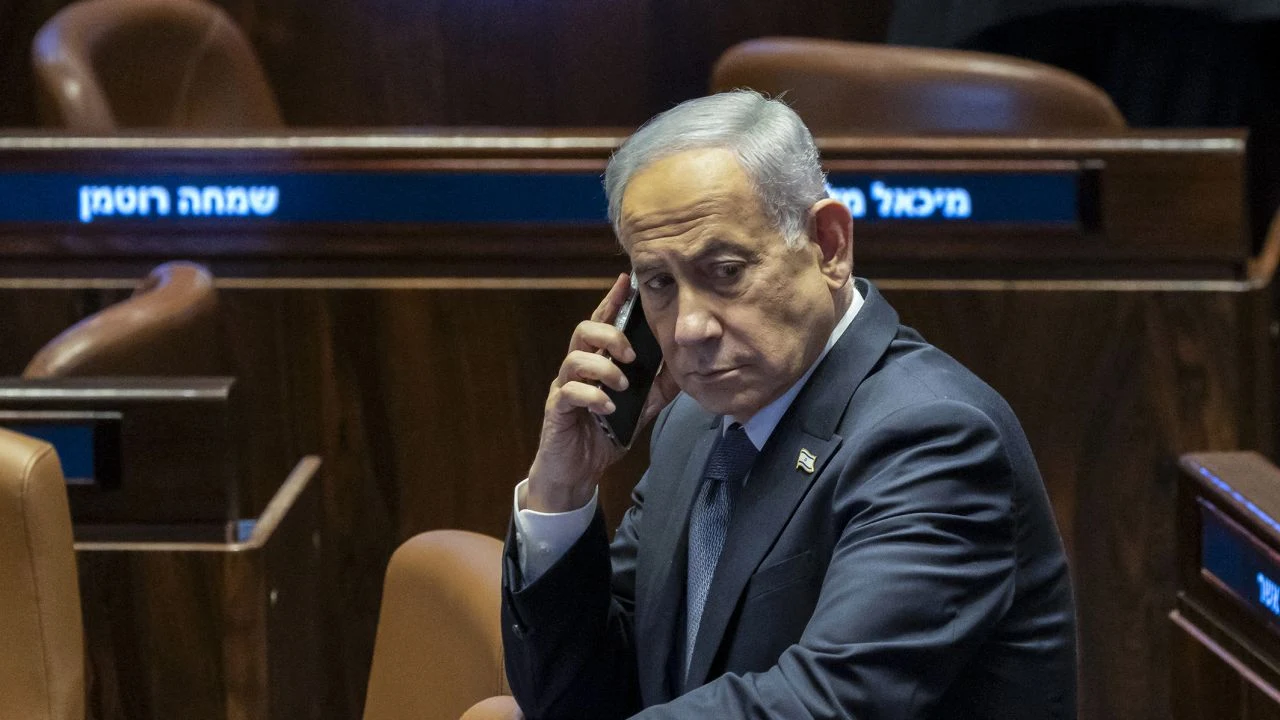
Benjamin Netanyahu has offered to let his rival Gadi Eisenkot serve first as prime minister in a rotating unity government, a major concession from Israel’s longest-serving leader as he risks losing power.
Netanyahu made the offer in a statement on X on Saturday evening. He said “unity is the need of the hour” and argued that he should lead the government, or go first in any rotation, because his Likud party is the largest in parliament. But he added that he would “set everything aside” and let Eisenkot take the first turn, with Netanyahu serving as alternate prime minister. He did not say how long Eisenkot’s first term would last.
The offer is a sign of how much pressure Netanyahu is under. Eisenkot, a former army chief, is close to putting together a coalition that could remove Netanyahu from office. Netanyahu called on Likud and Eisenkot’s Yashar party to “immediately begin genuine, sincere, and accelerated negotiations” and said the other side should also be ready to make compromises.
Eisenkot Response and Sunday Meeting
Eisenkot answered within hours. He invited Netanyahu and his team to meet “tonight” for genuine and accelerated talks on basic guidelines and policy. He also said he had already sent Netanyahu a detailed proposal, with significant compromise positions, a week ago through a secret channel — and that Netanyahu had yet to respond.
Likud later said the two men had spoken and agreed to meet on Sunday morning.
Eisenkot has already signed coalition deals with two partners: the right-wing Yisrael Beiteinu party and the left-wing Democrats. He has until 20 December to form a government if he asks for a two-week extension, and he has promised to bring a new government to a vote in parliament as early as next week.
Some of Eisenkot’s allies dismissed Netanyahu’s offer at once. They called it a bluff designed to buy time and to block the effort to replace him. Eisenkot himself had said on Friday that “unity is about substance and values, not about who gets which job or who goes first.”
Why Netanyahu Made Offer Now
To understand the offer, it helps to know how Israel reached this point. A general election on 27 October ended in a deadlock. No group won enough seats to govern on its own. Israel’s parliament, the Knesset, has 120 seats, and a government needs 61 of them.
President Isaac Herzog then asked Eisenkot to try to form a government. Eisenkot won the backing of 67 of the 120 members of parliament, while Netanyahu won 46. Netanyahu’s right-wing and religious bloc holds 53 seats. Eisenkot’s four-party alliance holds 48. Arab-led parties hold a record 19 seats.
That arithmetic is the heart of the story. Netanyahu’s bloc is the biggest single group, but it is still eight seats short of a majority. Eisenkot’s alliance is smaller, yet it has been winning support from partners on both the left and the right. If Eisenkot can reach 61 seats, Netanyahu’s long run in power ends.
A rotation deal is a simple idea. Two leaders take turns as prime minister for a fixed period each. Israel has used the idea before. Netanyahu is now offering to go second — a step he would not have taken while he still held a clear path to power. In his statement, he said that “given the magnitude of the existential threat and the possibility that a government could be formed that isn’t able to deal with this danger,” his “responsibility as a leader” required him to “put everything aside.”
What happens next depends on the Sunday meeting. If the two sides agree on basic policies, a unity government is possible. If they do not, Eisenkot will keep building his own coalition, and he has said he wants a vote in parliament as early as next week. Either way, the next few days will decide whether Netanyahu stays in office or leaves it.
Key Facts
| Fact | Detail |
|---|---|
| Netanyahu offer | Let Eisenkot serve first as PM in rotation deal |
| Netanyahu role if deal agreed | Alternate prime minister |
| Offer made | Saturday evening, 28 November 2026, on X |
| Eisenkot response | Invited Netanyahu to talks “tonight”; detailed proposal sent a week ago |
| Next meeting | Sunday morning, 29 November 2026 |
| Election date | 27 October 2026 (deadlocked) |
| Eisenkot mandate backing | 67 of 120 Knesset members |
| Netanyahu backing | 46 of 120 Knesset members |
| Netanyahu bloc seats | 53 |
| Eisenkot alliance seats | 48 |
| Arab-led parties seats | 19 |
| Majority needed | 61 of 120 |
| Eisenkot deadline | 20 December 2026 (with two-week extension) |
| Eisenkot coalition partners signed | Yisrael Beiteinu, Democrats |
FAQs
What did Netanyahu offer Eisenkot?
Netanyahu offered to let Eisenkot serve first as prime minister in a rotating unity government, with Netanyahu as alternate prime minister. He did not say how long Eisenkot’s first term would last.
Why is Netanyahu making this offer now?
Eisenkot is close to forming a coalition that could remove Netanyahu from power. Netanyahu’s bloc holds 53 of the Knesset’s 120 seats, eight short of the 61 needed for a majority.
What happens next?
Netanyahu and Eisenkot agreed to meet on Sunday morning. Eisenkot has also promised to bring a new government to a parliamentary vote as early as next week if the unity talks fail.