China said on Sunday that reunification with Taiwan cannot be stopped, hours after final results from Taiwan’s local elections showed a split verdict. The ruling Democratic Progressive Party (DPP) doubled its tally of cities and counties, while the opposition Kuomintang (KMT) kept control of the capital, Taipei.
Beijing’s Taiwan Affairs Office said it had “noted” the result. In a statement, it said that “mainstream public opinion” in Taiwan wanted peace, development, exchanges and cooperation — and that no change in Taiwan’s internal politics could stop reunification.
Beijing Response After Taiwan Vote
The statement was Beijing’s first formal response to Saturday’s vote. It said: “No matter how the internal political situation in the island changes, it cannot change the direction and trend of the forward development of exchanges across the Taiwan Strait.”
It went further: “Moreover, it cannot stop the historical trend that the motherland must and inevitably will be reunified.”
China views Taiwan, which governs itself democratically, as its own territory. It has never ruled out using force to bring the island under its control. Taiwan’s government rejects Beijing’s claim and says only the island’s people can decide their future.
Beijing also said it would continue to “firmly crack down on Taiwan independence separatist forces and oppose external interference”. China refuses to speak with Taiwan’s President Lai Ching-te, whom it calls a “separatist”. Lai, who also leads the DPP, says only Taiwan’s people can decide their future.
The response came a day after Chinese warplanes flew near Taiwan. Taiwan’s defence ministry said about 33 Chinese warplanes, along with eight warships, operated around the island on Friday, just before the vote.
KMT Keeps Taipei, DPP Doubles Seats
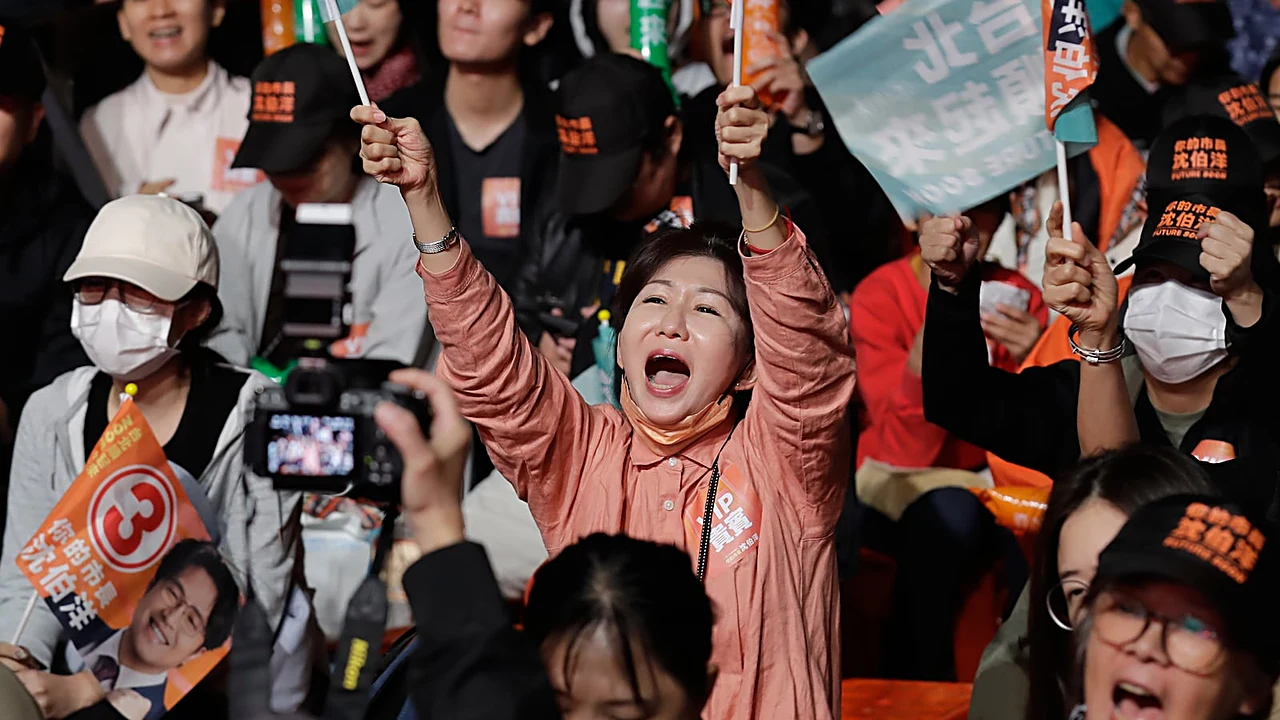
Taiwan voted on Saturday for mayors and county chiefs in all 22 of its cities and counties, along with local councillors. Final counts gave the KMT 11 of the 22 top local posts, the DPP 10, and one independent.
That is a sharp change from 2022, when the KMT won 14 posts and the DPP won only five. The DPP doubled its tally, its best local showing since 2014 — but it still fell short of the KMT overall.
In Taipei, the most watched race of the night, KMT incumbent Chiang Wan-an won a second term. He took about 53.8% of the vote against DPP challenger Puma Shen, who took about 45.6%, with almost 90% of polling stations counted. Shen, an academic turned lawmaker whom Beijing has sanctioned and labelled a separatist, conceded and called Chiang to congratulate him.
The DPP has won the Taipei mayorship only once, in 1994. Chiang thanked Shen after the result. “Together, we have completed a celebration of democracy,” he said. Shen said the result was real and Taiwan’s democracy could be trusted. “No matter who wins in the end, it will be a victory for Taipei and a victory for democracy,” he said.
Elsewhere, the DPP flipped Taichung, the island’s second-most-populous city, along with Changhua, Chiayi City, Hsinchu County, Yilan and Yunlin. The KMT took Penghu from the DPP. Across Taiwan’s six largest cities, the two parties won three each. Two races were decided by only a few hundred votes, and recounts are expected.
Voters also backed a national referendum on nuclear power. More than 7.4 million people voted yes, against about 4.6 million no, with turnout near 63%. The proposal calls for using nuclear energy to support the economy and dropping the “nuclear-free homeland” policy. It does not by itself reopen any nuclear plant — Taiwan’s last reactor shut last year — but it gives the government a political mandate to pursue nuclear power. Supporters say extra energy is needed to meet the artificial intelligence industry’s growing demand for electricity.
Why Vote Matters
Local elections in Taiwan are usually about roads, schools, childcare and the cost of living — not about China. Saturday’s vote was no different: most candidates campaigned on transport, welfare and other everyday issues.
But the result still matters far beyond town halls. Taiwan sits at the centre of one of the world’s most dangerous disputes. China claims the island and has built up its military around it, while the United States supplies Taiwan with arms. Any shift in Taiwan’s politics is read in Beijing and Washington as a signal about where the island is heading.
For the DPP, doubling its local posts is a boost before the next big test: presidential and parliamentary elections in early 2028. President Lai will almost certainly seek a second term, the most the constitution allows. A political science professor at National Taiwan University, Chen Shihmin, called the result a modest victory for the DPP. “This result will allow the DPP to be united in supporting (President) Lai Ching-te when he seeks another term in 2028,” he said.
For the KMT, keeping Taipei and its northern strongholds shows it remains the stronger party at local level. The KMT favours closer ties with Beijing — its chair, Cheng Li-wun, met Chinese President Xi Jinping in April. But the party has not yet confirmed who will lead it into the 2028 presidential race.
The nuclear vote matters too. Taiwan’s chip and AI industries use huge amounts of power, and voters have now backed a return to nuclear energy. The government must still decide how to act on that mandate, and when.
Key Facts
| Election date | Saturday, 28 November 2026 |
| Posts decided | 22 city and county chiefs, plus local councillors |
| Final split | KMT 11, DPP 10, independent 1 |
| 2022 split | KMT 14, DPP 5 |
| Taipei mayor | Chiang Wan-an (KMT) re-elected, about 53.8% vs Puma Shen (DPP) about 45.6% |
| DPP last won Taipei | 1994 |
| Largest-city split | DPP 3, KMT 3 of six largest cities |
| DPP flips | Taichung, Changhua, Chiayi City, Hsinchu County, Yilan, Yunlin |
| Nuclear referendum | Passed — more than 7.4 million yes vs about 4.6 million no; turnout near 63% |
| Chinese warplanes before vote | About 33 aircraft plus 8 warships on Friday |
| Beijing statement | Sunday, 29 November — reunification “cannot be stopped” |
| Next big vote | Presidential and parliamentary elections, early 2028 |
Frequently Asked Questions
Neither party won outright. The KMT took 11 of 22 city and county chief posts, the DPP took 10, and an independent took one. The DPP doubled its 2022 tally of five, while the KMT fell from 14 — so the DPP gained ground, but the KMT still leads at local level.
Beijing’s Taiwan Affairs Office said on Sunday that reunification “cannot be stopped” and that no change in Taiwan’s internal politics could change the trend. It said it would keep cracking down on independence forces and opposing outside interference. China claims Taiwan as its territory; Taiwan’s government rejects that claim.
Voters backed a referendum calling for nuclear energy to support the economy and dropping the “nuclear-free homeland” policy. More than 7.4 million voted yes against about 4.6 million no. The vote does not reopen any plant by itself, but it gives the government a mandate to pursue nuclear power.