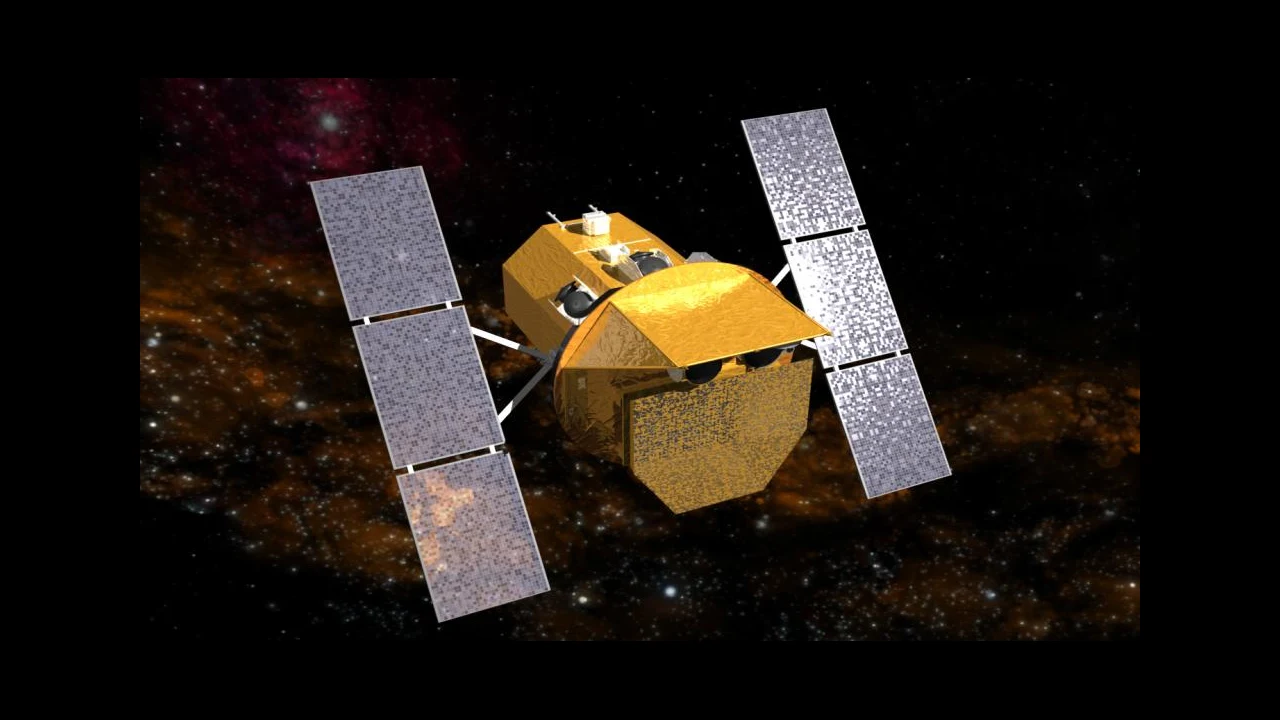
NASA’s Neil Gehrels Swift Observatory is falling back to Earth after 22 years in orbit, closing a mission that turned the telescope into astronomy’s fastest responder to the universe’s most violent explosions.
Why the return matters is that Swift spent more than two decades as the first alert system for exploding stars and colliding cosmic objects, cueing larger telescopes such as Hubble and Webb to look deeper. Its loss leaves a gap in rapid follow-up observations, and its uncontrolled descent is being watched closely because a small number of dense parts could survive the fiery trip through the atmosphere.
Most of the 1.5-tonne observatory is expected to burn up during reentry, according to NASA. Mission chief scientist Brad Cenko has said a handful of pieces made of tungsten, a metal denser than lead, along with parts of the telescope’s mirrors, could survive the heat and reach the surface.
Any surviving wreckage will most likely plunge into the ocean, NASA has said. Because Swift orbits at an inclination of about 21 degrees, its possible debris band runs between 21 degrees north and 21 degrees south of the equator, covering swaths of Africa, Australia, India, Southeast Asia, and Central and South America. Ewan Wright, of the University of British Columbia’s Outer Space Institute, has noted that the band covers a region where oceans make up most of the surface, and NASA public affairs specialist Alise Fisher has said the risk of harm to anyone on Earth is unlikely.
Exact timing remains uncertain. The US Space Force has been tracking Swift’s shrinking orbit, and in the Associated Press account published on October 31 it expected the return around Friday, without pinning down a precise landing place. A separate tracker, the Center for Orbital and Reentry Debris Studies at The Aerospace Corporation, projects reentry at 09:30 UTC on November 4, with 26 hours of uncertainty on either side, based on orbital data dated October 30. NASA’s own update on October 23 put the window more broadly, saying reentry could occur within the coming weeks. No agency has yet confirmed a final time or location, and the prediction will narrow only as the spacecraft drops lower.
Failed rescue sealed Swift’s fate
Intense solar activity over the past few years dragged Swift down faster than planned, as an expanded upper atmosphere increased drag on the spacecraft. NASA hired Arizona-based Katalyst Space about a year ago to mount a rush rescue, paying a reported $30 million for the attempt.
Katalyst built a three-armed robotic spacecraft called Link and launched it on July 3. The robot ran into attitude-control trouble after launch and got no closer than 7 to 9 miles (12 to 15 kilometres) to the telescope, according to reports of the mission. The boost attempt was abandoned in August, and Link itself plunged back to Earth in September.
“We’ve known this day would come since before Swift was launched. At least in low-Earth orbit, what goes up must come down. And that end is catastrophic,” Pennsylvania State University astronomer John Nousek, who led the mission’s control team, said in the Associated Press account.
Swift resumed observations once the rescue attempt was called off, detecting even more gamma-ray bursts and other ultrahigh-energy events. But by late October, its orbit had dropped too low for steady observations. NASA said the spacecraft fell to about 171 miles (275 kilometres) by October 20, entered safe mode, and made its final observation that day. Science operations were formally ended on October 23, and controllers shut the systems down.
Discoveries continued until observations ended
Swift blasted off on November 20, 2004, on a Delta II rocket, to search for gamma-ray bursts and supernovas, the biggest explosions in the universe. It was designed for a two-year primary mission but kept working for more than two decades, and in 2018 NASA renamed it for Neil Gehrels, its first principal investigator.
Its final tally runs to more than 2,000 gamma-ray bursts and 1,400 exploding stars, along with comets, asteroids and star-shredding black holes. Swift’s data has contributed to roughly 7,000 published scientific papers, and its archive holds nearly 22 years of brightness measurements, multiwavelength spectra and more than 1.5 million images from its ultraviolet and optical telescope.
NASA considered Swift a first responder for the Hubble and Webb space telescopes and others, which followed its alerts and provided deeper investigations. Scientists are still figuring out how to fill that gap, and Nousek said the team’s hope is that the lessons of Swift’s successes can be applied to new generations of space missions.
What is confirmed is that Swift’s science mission is over, that most of the spacecraft will burn up, and that trackers are watching a reentry expected in the coming days. What is not confirmed is exactly when it will come down or whether any debris will reach land. Until the final hours of descent, that answer stays open, and the telescope that spent 22 years watching the sky explode will end its own story in a streak of fire.