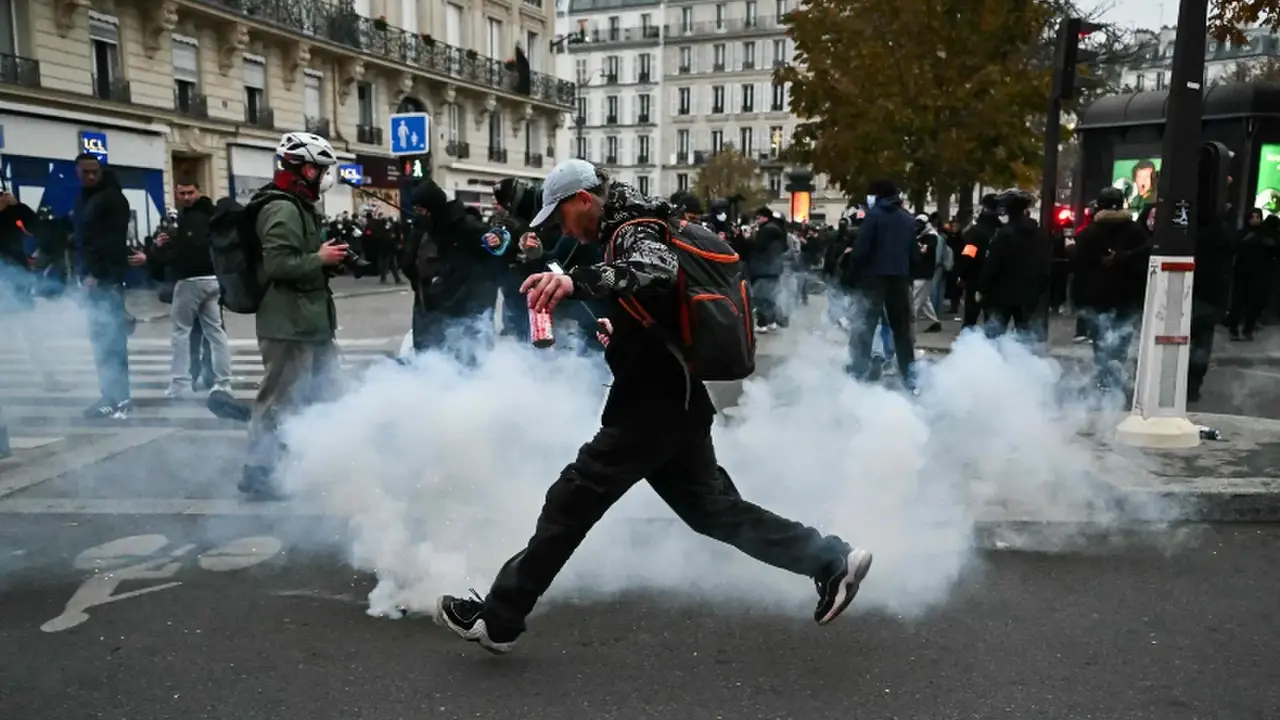
Thousands of people marched across France on Saturday, 7 November 2026. Anger over the rising cost of living filled streets in Paris and in cities across the country. The day ended in clashes in Paris, as police fired tear gas at crowds near the end of the main march.
It was the fourth weekend in a row of protests. The movement began with students. It has now grown into a wider protest about prices, wages and daily life. Students are still at the heart of it. But workers, teachers and many other groups have joined them.
The government is under pressure from two sides. People want help with bills. At the same time, France owes a huge amount of money. That debt limits what the government can spend. The protests show how hard that balance has become.
Clashes in Paris as Police Fire Tear Gas
The main Paris march ran from Republique to Nation. Trouble broke out near the end of the route. Police fired tear gas at people who threw projectiles and homemade fireworks. Officers moved in as the crowd reached the end of the march.
Police said a group of about 200 violent individuals attacked officers. The officers were arresting a man who had set fire to a rubbish bin. The clash grew from that arrest. Tear gas filled the air as people ran for cover.
There was also trouble in Lyon. Police there fired tear gas at several hundred people who were blocking a road. Across France, 70,000 security personnel were on duty. By the evening, police had made 360 arrests across the country.
A rival rally by the Yellow Vests was banned. It was due to take place at Place de la Concorde, near the Elysee Palace. Police surrounded about 100 people at the site. Coordinators Benjamin Ball and spokeswoman Azelma Sigaux were among those arrested.
Shops along the Paris route felt the impact. Many boarded up their windows before the march. Shop manager Jean Emile Moulinier said his shop sits on the protest route. He said hardly any customers brave the barricades. “So this can’t go on, otherwise I think it will be a disaster before long,” he said.
The violence was not on the scale of 17 October. Those protests brought the worst riots in France in years. But Saturday still showed how tense the streets have become.
Turnout Falls for Fourth Weekend
The interior ministry counted 146,000 people across France on Saturday. That figure included 46,000 people in Paris. Unions gave a higher count. They put the total at 250,000 across France, including 75,000 in Paris.
Both counts were lower than the three weekends before. The fall in numbers does not mean the anger has gone. It may mean people are tired after weeks of marching. It may also mean the movement is changing shape, with strikes now set to play a bigger part.
| Key figure | Number |
|---|---|
| Turnout nationwide (ministry) | 146,000 |
| Turnout in Paris (ministry) | 46,000 |
| Turnout nationwide (unions) | 250,000 |
| Turnout in Paris (unions) | 75,000 |
| Security personnel deployed | 70,000 |
| Arrests nationwide | 360 |
| Thursday protest turnout | 575,000 (ministry) / 1,600,000 (unions) |
Saturday came two days after a large union protest on Thursday. The ministry counted 575,000 people at that protest. Unions put the figure at 1.6 million. The gap between the two counts is normal in France. The ministry and the unions use different ways to count crowds.
The lower Saturday turnout still matters. It was the fourth weekend in a row with large marches. Few protest movements keep that pace for a month. The numbers show that the issue of living costs still brings people out, even if fewer than before.
Why France Keeps Protesting
The protests began in late September 2026. High school students walked out over poor conditions in their schools. They said classrooms were crowded and buildings were in poor shape. University students joined them soon after.
The movement then grew wider. It is now about the cost of living as a whole. Food prices have risen. Fuel prices have risen. Wages have not kept up. Many families find it hard to pay for daily needs at the end of the month.
That is why the protest matters to so many people. It is not only about schools. It is about whether pay covers the cost of a normal life. For students, it is also about their future. They worry about jobs, housing and the price of study.
The government faces a hard choice. It wants to help people with wages and prices. But France has a huge debt pile. That debt limits how much the state can borrow and spend. Any new help must fit inside tight public finances.
Politics adds to the pressure. France will hold a presidential election in April 2027. Polls put far-right leader Marine Le Pen as the favourite. Hard-left leader Jean-Luc Melenchon is seen as her main rival. Both of them are watching the protests closely.
Melenchon spoke to about 20,000 supporters outside Paris on Saturday. He told the crowd, “we are going to win”. He also said “everything must change”. He pledged to boost the economy through consumer spending. He said this could be done using “billions [of euros] that already exist”.
What Happens Next in France
Prime Minister Sebastien Lecornu will meet unions and employers on Monday. They will discuss wages and purchasing power. The talks are a key test. Protesters want real gains, not just words.
Student and teacher groups have called a new strike for Tuesday. They want more spending on education. They say they are “in a position of strength”. They also say the government is “starting to yield”. A strong turnout on Tuesday would add to that pressure.
The coming days will show if talks can calm the streets. If the Monday meeting brings no clear offer, more protests may follow. If the Tuesday strike is large, the government may face a new round of talks. For now, the movement shows no sign of ending.
For people in France, the question is simple. Will pay rise fast enough to match prices? Will schools get the money they need? The answers will shape the months before the election. They will also shape daily life for millions of families.
The protests began in late September 2026 when high school students walked out over poor conditions in their schools. University students joined them, and the movement grew into a wider protest about the rising cost of living, with wages failing to keep up with food and fuel prices.
The interior ministry counted 146,000 people across France, including 46,000 in Paris. Unions gave a higher figure of 250,000 nationwide, including 75,000 in Paris. Both counts were lower than the previous three weekends.
Prime Minister Sebastien Lecornu meets unions and employers on Monday to discuss wages and purchasing power. Student and teacher groups have called a new strike for Tuesday, and France heads to a presidential election in April 2027.